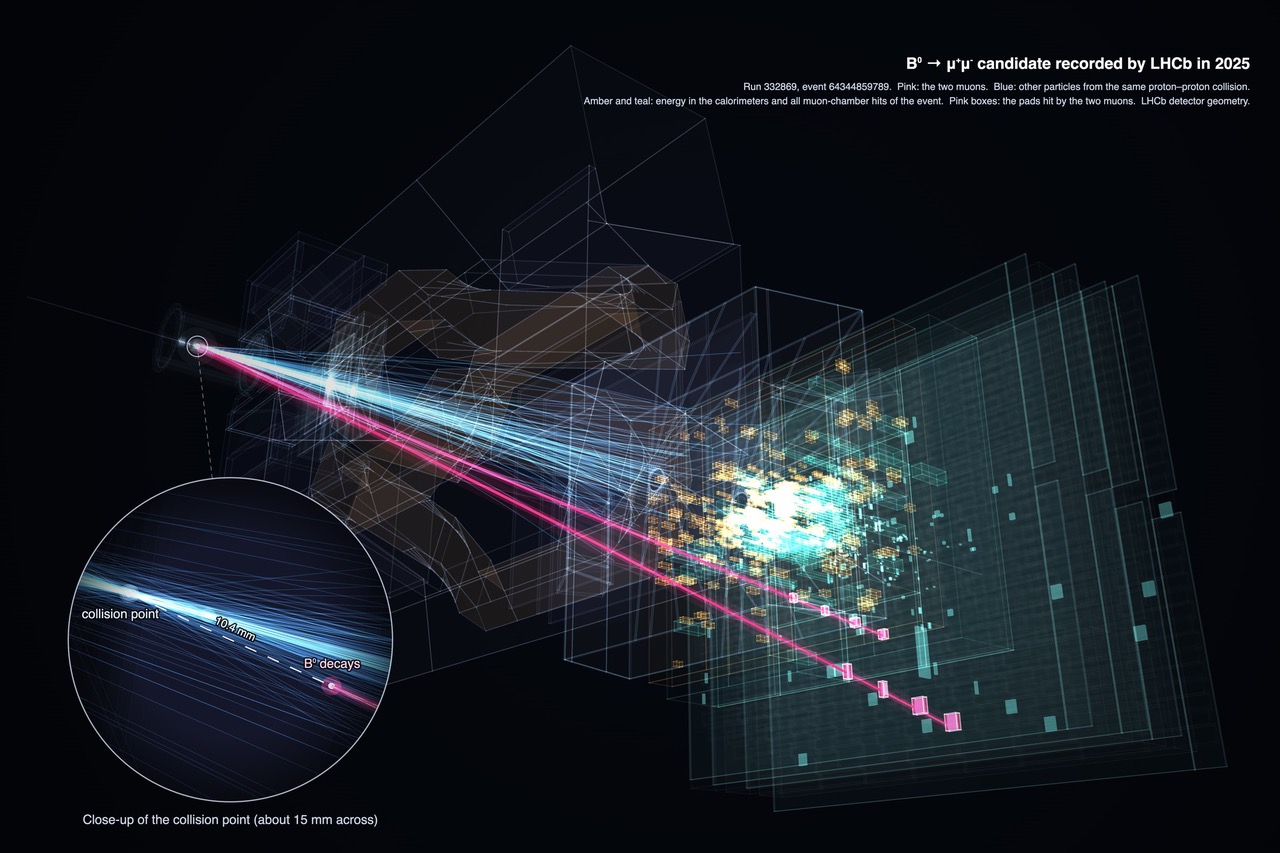
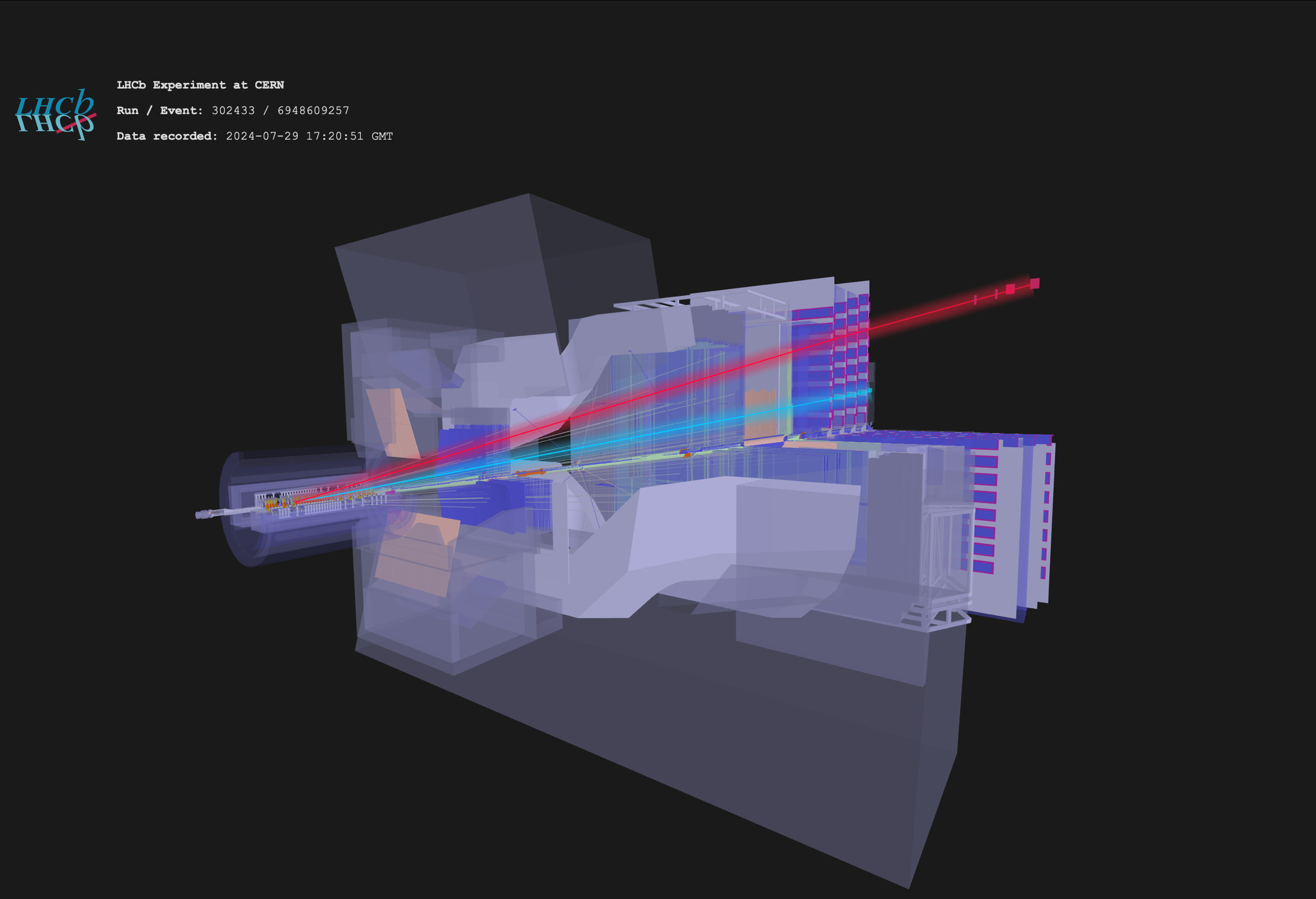
The process could become the rarest beauty-particle decay ever observed
They say good things come to those who wait, and the LHCb Collaboration’s latest result marks a major milestone in a search that has lasted decades. In a seminar held at CERN today, the Collaboration announced evidence of a beauty-particle decay that happens only about once in every ten billion decays – the first time this has been achieved using data from a single experiment.
The particle in question, known as B⁰, is made of a beauty antiquark and a down quark. Very rarely, it decays into a pair of muons (B⁰→μ⁺μ⁻) – particles similar to electrons, but about 200 times heavier. In this process the two quarks annihilate and their energy turns into a muon and its antiparticle. According to quantum physics, this can only happen with the help of fleeting “virtual” particles, some of them far too heavy to be produced directly in LHC collisions. Unknown heavy particles could take part too, changing how often the decay occurs. That is why measuring it precisely could reveal signs of physics beyond the Standard Model.
In general, the rarer a decay, the more sensitive it is to the influence of new particles. B⁰→μ⁺μ⁻ and its sibling B⁰s→μ⁺μ⁻ are so rare that they have long been regarded as “golden channels” in the hunt for new physics. B⁰s→μ⁺μ⁻ occurs only about three times in every billion B⁰s decays, and B⁰→μ⁺μ⁻ is predicted to be around 30 times rarer still. Physicists have been chasing these decays for more than forty years. Italian physicists have played a leading role throughout this search, coordinating LHCb’s previous analyses of these decays, including the one that in 2017 delivered the first observation of B⁰s→μ⁺μ⁻ by a single experiment.
To claim evidence for a new phenomenon, a result needs a significance of 3 “standard deviations”, meaning there is less than a 0.3% chance that a random fluctuation alone would produce such a signal. In 2022, a major upgrade allowed LHCb to record collisions at five times the previous rate. INFN and Italian universities played a key role in this transformation, particularly in the particle-identification systems. Data collected by LHCb in 2024 and 2025 reveal B⁰→μ⁺μ⁻ at a level of 3.0 standard deviations. Combining them with data collected between 2011 and 2018 raises the significance to 3.2 standard deviations, above the evidence threshold. The same analysis also yielded the most precise measurement to date of the B⁰s→μ⁺μ⁻ decay rate. The LHCb group from the Department of Physics of the University of Rome Tor Vergata took part in the new analysis.
The next goal is to reach 5 standard deviations, the threshold for a confirmed observation. This would make B⁰→μ⁺μ⁻ the rarest beauty-particle decay ever observed. The start of the High-Luminosity LHC in 2030 and a planned upgrade of LHCb in the mid-2030s, on which the Italian community is already actively working, could increase the data collection rate by another factor of ten.
Contacts: Federico Manganella (federico.manganella@roma2.infn.it), Flavio Archilli (flavio.archilli@roma2.infn.it), Alessia Satta (alessia.satta@roma2.infn.it), Emanuele Santovetti (emanuele.santovetti@roma2.infn.it)
Links:
LHCb - news